

dmx-fun 0.1.0 is out — and it is the release we have been building toward since day one.
This is not a version bump. 0.1.0 is the first stable, production-ready release of dmx-fun. The API is stable. The ecosystem is complete. The contracts have been audited. If you have been waiting for the right moment to adopt dmx-fun in a production backend, this is it.
What does “production ready” mean here?
When we say production ready, we mean it precisely:
- Stable API — no breaking changes to core types or module contracts without a major version bump.
- Verified interoperability — every core type has been audited for composition correctness across the entire library and with the Java standard library.
- Battle-tested — the modules have been exercised through compatibility matrices, real database integration tests, and end-to-end reference applications.
- Complete Javadoc — no warnings, no gaps.
- Transaction guarantees —
fun-springandfun-quarkusbehave exactly as Spring Boot and Quarkus developers expect from@Transactional, but with functional return types.
A rich ecosystem, not just a library
dmx-fun is no longer a single artifact. It is a coordinated ecosystem of modules designed to
work together — and to integrate cleanly with the frameworks and infrastructure you already use.
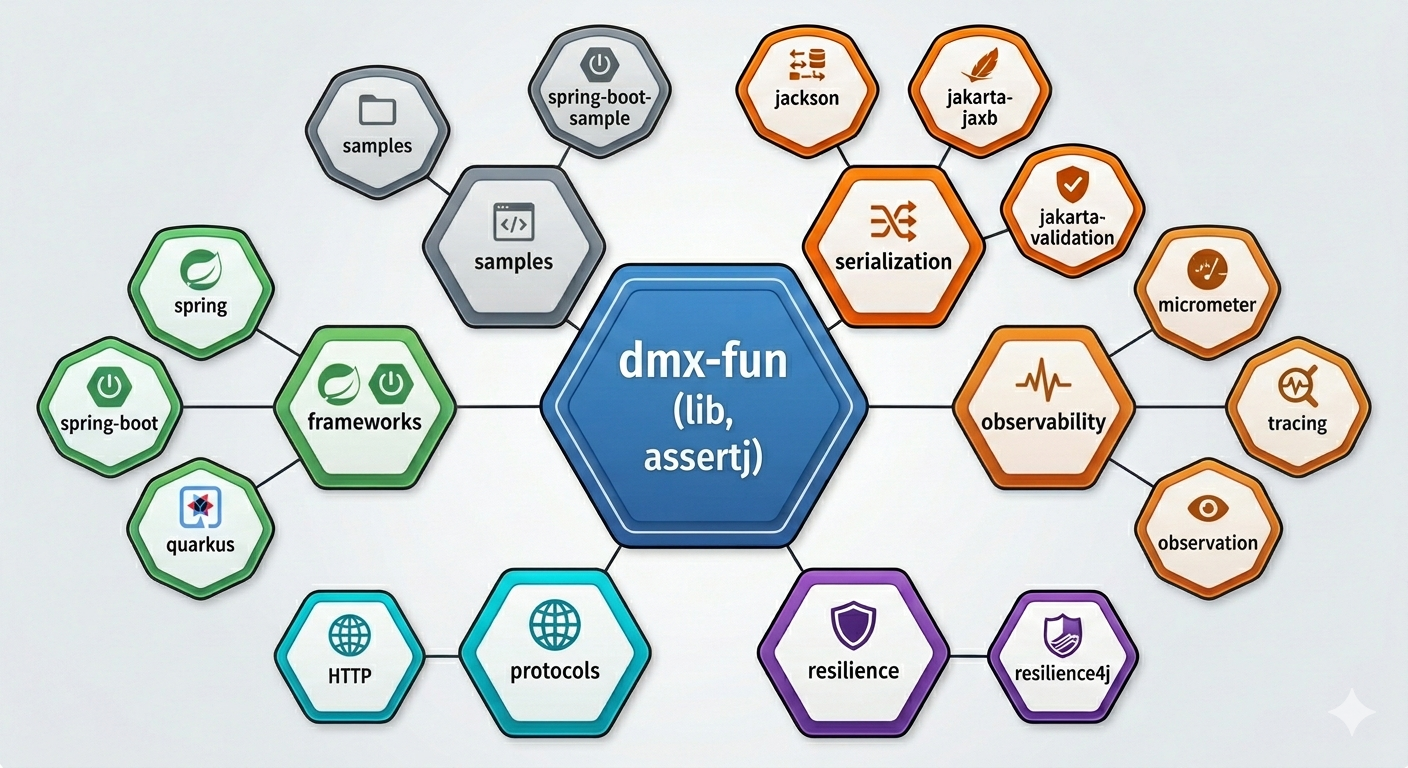
The modules are organized into logical groups:
| Group | Modules |
|---|---|
| Core | fun-lib · fun-assertj |
| Serialization | fun-jackson · fun-jakarta-jaxb · fun-jakarta-validation |
| Observability | fun-micrometer · fun-tracing · fun-observation |
| Frameworks | fun-spring · fun-spring-boot · fun-quarkus |
| Protocols | fun-http |
| Resilience | fun-resilience4j |
| Samples | samples · spring-boot-sample |
Every module is independently versioned and published to Maven Central. Use the BOM to keep them all aligned without managing individual versions:
// Gradle (Kotlin DSL)implementation(platform("codes.domix:fun-bom:0.1.0"))implementation("codes.domix:fun-lib")implementation("codes.domix:fun-spring-boot")implementation("codes.domix:fun-resilience4j")<!-- Maven --><dependencyManagement> <dependencies> <dependency> <groupId>codes.domix</groupId> <artifactId>fun-bom</artifactId> <version>0.1.0</version> <type>pom</type> <scope>import</scope> </dependency> </dependencies></dependencyManagement>Spring Boot integration
fun-spring-boot provides zero-configuration autoconfiguration for all dmx-fun types inside
a Spring Boot application.
Drop in the dependency and you get:
TxResult/TxTry/TxValidatedregistered as beans — execute functional suppliers inside managed transactions that roll back on failure, not just on thrown exceptions.@TransactionalResult/@TransactionalTry/@TransactionalValidated— annotation-driven equivalents backed by AOP, comparable to@Transactionalbut aware of functional failure states.- Jackson autoconfiguration —
DmxFunModuleis applied automatically to theObjectMapper, soOption,Result,Try,Either, andValidatedserialize and deserialize out of the box. - Spring MVC return value handlers — controllers can return
Option<T>,Result<V, E>,Try<V>, andValidated<E, A>directly.Option.some(v)becomes HTTP 200;Option.none()becomes HTTP 404.Result.ok(v)becomes HTTP 200;Result.err(e)becomes HTTP 500. DmxTracing— auto-registered when Micrometer Tracing is on the classpath. Zero configuration.
@RestControllerclass OrderController {
    private final OrderService orders;
    @GetMapping("/orders/{id}")    Option<Order> get(@PathVariable String id) {        return orders.findById(id);   // 200 with body, or 404 — no if/else needed    }
    @PostMapping("/orders")    Result<Order, OrderError> create(@RequestBody OrderRequest req) {        return orders.create(req);    // 200 with order, or 500 with typed error    }}
Spring Boot 3.3.x through 4.0.x are all tested in CI on every pull request.
Quarkus integration
fun-quarkus brings the same transactional guarantees to Quarkus applications.
The core problem it solves is the silent commit problem: Quarkus’s @Transactional commits
even when a method returns a Result.err(...) or Try.failure(...), because those are not
exceptions. fun-quarkus fixes this:
@ApplicationScopedclass PaymentService {
    @Inject TxResult txResult;
    Result<Payment, PaymentError> charge(ChargeRequest req) {        return txResult.execute(() -> {            // if this returns Err, the transaction rolls back            return paymentRepository.persist(req);        });    }}
Or use the annotation-driven style:
@ApplicationScopedclass PaymentService {
    @TransactionalResult    Result<Payment, PaymentError> charge(ChargeRequest req) {        return paymentRepository.persist(req); // Err → rollback    }}
All six JTA propagation types are supported: REQUIRED, REQUIRES_NEW, MANDATORY,
SUPPORTS, NOT_SUPPORTED, and NEVER. The module ships as a proper Quarkus extension
with META-INF/quarkus-extension.properties — no explicit deployment dependency needed.
Tested against Quarkus 3.11.3, 3.21.4, 3.31.4, and 3.35.1 via CI compatibility matrix, with integration tests running against a real PostgreSQL instance via Quarkus Dev Services.
Interoperability audit: the work behind the stability
The defining work of 0.1.0 was a systematic interoperability audit across all twelve core types. Every type was verified — and expanded where needed — to compose correctly with the rest of the library and with the Java standard library.
Here is a sample of what the audit delivered:
Either gained toOptional(), stream(), toTry(leftMapper), match(onLeft, onRight),
flatMapLeft(Function), symmetric fallback extractors (getRightOrElse, getLeftOrElse, etc.),
and streamLeft().
Option gained fromEither(Either<L,R>) and toFuture() — Some(v) becomes a
completed future; None becomes a failed future with NoSuchElementException.
Result and Try each gained fromEither static factories and toOptional() conversions.
Lazy gained toOptional(), toEither(), and toEither(errorMapper) — safe conversions
that force evaluation and capture exceptions as Left.
Resource gained useAsEither(body, onError) — the Either-integrated counterpart of
useAsResult, eliminating awkward Try<Either<E, R>> nesting.
NonEmptyList, NonEmptyMap, and NonEmptySet all gained fromOptional factories,
stream-based collectors, and sequence* methods for fail-fast sequencing over elements.
Resilience, observability, and HTTP
Production backends need more than types. They need circuit breakers, retries, metrics, tracing, and HTTP clients that do not leak exceptions.
fun-resilience4j wraps Retry, CircuitBreaker, RateLimiter, and Bulkhead — each exposing
executeTry(supplier), executeResult(supplier), and executeResultTyped(supplier) so
every policy outcome becomes a typed value rather than a thrown exception.
fun-micrometer wraps a MeterRegistry and records counters, timers, and failure tags
automatically around Try- and Result-returning suppliers.
fun-tracing and fun-observation wrap Micrometer Tracing and the Observation API respectively,
tagging failure outcomes on the active span or observation.
fun-http wraps the JDK HttpClient and returns Result<T, HttpError> — network failures,
non-2xx responses, and deserialization errors are all first-class typed values.
What is in the box
A complete summary of the core types available in fun-lib:
| Type | Purpose |
|---|---|
Option<T> |
Presence or absence — an explicit alternative to null |
Result<V, E> |
Success or typed error — fail-fast, non-exception-based |
Try<V> |
Success or Throwable — bridges exception-based APIs |
Either<L, R> |
Disjoint union — two typed branches, no preferred side |
Validated<E, A> |
Accumulating validation — collects all errors, not just the first |
Lazy<T> |
Memoized deferred evaluation |
Guard<T> |
Composable null-safe predicate blocks |
Accumulator<E, A> |
Value with an accumulated side-channel |
Resource<T> |
Functional managed resource with guaranteed release |
NonEmptyList<T> |
Compile-time non-empty list |
NonEmptyMap<K, V> |
Compile-time non-empty map |
NonEmptySet<T> |
Compile-time non-empty set |
Tuple2/3/4 |
Immutable typed product types |
Getting started
// Gradle (Kotlin DSL) — core library onlyimplementation("codes.domix:fun-lib:0.1.0")
// Spring Boot project — use the BOMimplementation(platform("codes.domix:fun-bom:0.1.0"))implementation("codes.domix:fun-lib")implementation("codes.domix:fun-spring-boot")
// Quarkus projectimplementation(platform("codes.domix:fun-bom:0.1.0"))implementation("codes.domix:fun-lib")implementation("codes.domix:fun-quarkus")
Full Javadoc is available at /dmx-fun/javadoc/. The Developer Guide covers every type and integration module with real-world examples.
The spring-boot-sample
module is a production-like reference application with Flyway, PostgreSQL, JPA, Micrometer metrics,
and Resilience4J patterns all working together — the best place to see the full ecosystem in action.
Found a bug or have a suggestion? Open an issue on GitHub.