Introduction
What is dmx-fun?
dmx-fun is a functional programming toolkit for Java 25+. It fills the gap between plain Java and full FP frameworks by providing a small set of precisely scoped types that eliminate the most common sources of runtime surprises: null references, swallowed exceptions, and silent partial failures.
The library depends on JSpecify for its null-safety
annotations (@NullMarked) — see ADR-008 for the rationale.
An optional fun-jackson module adds JSON serialization for all types.
Core philosophy
Make illegal states unrepresentable.
Types like Option<T>, Result<V,E>, and NonEmptyList<T> encode constraints
directly in the type system. A method returning Option<T> cannot accidentally
return null; a method returning NonEmptyList<T> cannot return an empty list.
The compiler enforces the contract, not a runtime check.
Explicit over implicit.
Absent values, domain errors, and thrown exceptions are all surfaced as first-class
values. Nothing is hidden in a null return, a swallowed catch block, or an
unchecked exception that only surfaces in production.
Composable by design.
Every type provides map, flatMap, and conversion methods to the other types.
A Try converts to Result; a Result converts to Option; a Validated
converts to Result. Pipelines stay clean because the plumbing is built in.
Pattern matching as the primary API.
All types are sealed interfaces with record variants (Option.Some/Option.None,
Try.Success/Try.Failure, Result.Ok/Result.Err, etc.). Java 21+ exhaustive
switch expressions are the idiomatic way to branch on them — compiler-checked,
without instanceof boilerplate, and with destructuring built in.
The type landscape
| Type | One-liner | Guide |
|---|---|---|
Option<T> |
A value that may or may not be present | Option guide |
Result<V, E> |
Either a success value or a typed domain error | Result guide |
Try<V> |
A computation that may throw, turned into a value | Try guide |
Validated<E, A> |
Like Result, but accumulates all errors instead of one | Validated guide |
Either<L, R> |
A neutral disjoint union — neither side means failure | Either guide |
Lazy<T> |
A value computed at most once, cached after first access | Lazy guide |
Tuple2/3/4 |
Typed heterogeneous groupings without a named class | Tuples guide |
NonEmptyList<T> |
A list with at least one element, enforced at compile time | NEL guide |
Accumulator<E, A> |
A value paired with a side-channel accumulation (log, metrics, audit trail) | Accumulator guide |
| Checked interfaces | CheckedFunction, TriFunction, QuadFunction, and more |
Checked interfaces guide |
Adding dmx-fun to your project
All artifacts are published to Maven Central under the codes.domix group.
Using the BOM (recommended when using multiple modules)
fun-bom is a Bill of Materials that centralizes all dmx-fun artifact versions
in one place. Import it once and omit the version from every individual module
declaration — the BOM keeps them in sync automatically.
Gradle
// Kotlin DSL — import the BOM, then declare modules without versionsdependencies {    implementation(platform("codes.domix:fun-bom:0.2.0"))
    implementation("codes.domix:fun")    implementation("codes.domix:fun-jackson")      // version managed by BOM    implementation("codes.domix:fun-spring-boot")  // version managed by BOM}
// Groovy DSLdependencies { implementation platform('codes.domix:fun-bom:0.2.0')
implementation 'codes.domix:fun' implementation 'codes.domix:fun-jackson' implementation 'codes.domix:fun-spring-boot'}Maven
<!-- Import the BOM in dependencyManagement --><dependencyManagement>  <dependencies>    <dependency>      <groupId>codes.domix</groupId>      <artifactId>fun-bom</artifactId>      <version>0.2.0</version>      <type>pom</type>      <scope>import</scope>    </dependency>  </dependencies></dependencyManagement>
<!-- Declare modules without versions --><dependencies>  <dependency>    <groupId>codes.domix</groupId>    <artifactId>fun</artifactId>  </dependency>  <dependency>    <groupId>codes.domix</groupId>    <artifactId>fun-jackson</artifactId>  </dependency>  <dependency>    <groupId>codes.domix</groupId>    <artifactId>fun-spring-boot</artifactId>  </dependency></dependencies>
Without the BOM (single module)
If you only need one module, declare it directly with an explicit version. Each module guide has a copy-ready snippet in its Adding the dependency section.
Available modules
Each integration is a separate artifact with the peer dependency declared compileOnly —
the rationale is documented in ADR-022 — Integration modules as optional peer dependencies.
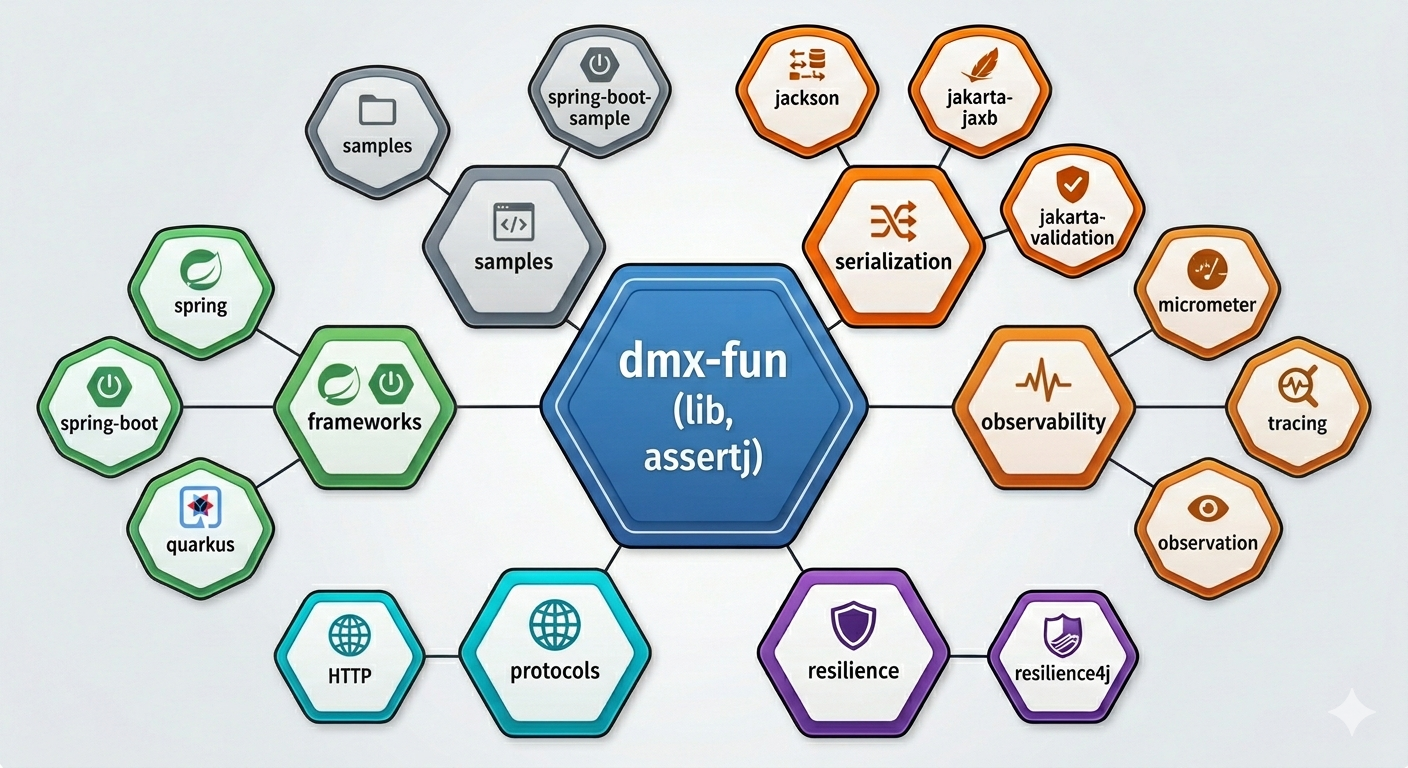
| Artifact | What it adds |
|---|---|
codes.domix:fun |
Core library — always required |
codes.domix:fun-assertj |
Fluent AssertJ assertions for all dmx-fun types |
codes.domix:fun-jackson |
Jackson serializers/deserializers |
codes.domix:fun-spring |
Spring Framework converters and utilities |
codes.domix:fun-spring-boot |
Spring Boot auto-configuration |
codes.domix:fun-spring-webflux |
Spring WebFlux adapters — Option/Result/Try/Validated to ServerResponse for functional endpoints |
codes.domix:fun-resilience4j |
Resilience4j integration |
codes.domix:fun-micrometer |
Micrometer instrumentation |
codes.domix:fun-tracing |
Micrometer Tracing — distributed tracing spans for Try and Result |
codes.domix:fun-observation |
Micrometer Observation — metrics and distributed tracing spans for Try and Result in one call |
codes.domix:fun-jakarta-validation |
Jakarta Validation integration — returns Validated instead of throwing ConstraintViolationException |
codes.domix:fun-jakarta-jaxb |
Jakarta JSON-B adapters for all dmx-fun types; JAXB adapters for Option, Result, Try, and Either |
codes.domix:fun-http |
java.net.http.HttpClient wrapper — returns Result<T, HttpError> with typed 4xx / 5xx / timeout / network-failure variants |
codes.domix:fun-reactor |
Project Reactor interop — convert Option, Result, and Try to/from Mono/Flux, with railway operators and sequence/collectValidated aggregation |
How to read this guide
Each type page follows the same structure:
- What it is — the problem it solves and when to reach for it
- Creating instances — factory methods and constructors
- Accessing / extracting values — safe and unsafe extraction
- Transforming —
map,flatMap,filter, and friends - Interoperability — conversion to other types
- Common pitfalls — the mistakes made most often
- Real-world example — a concrete, idiomatic usage
Types interoperate — the Combining Types page covers the full conversion matrix and cross-type composition patterns.
For performance expectations and design trade-offs, see the Performance page.
A taste of composition
The snippet below registers a user by combining three types, each doing what
it does best: Try for exception handling, Validated for collecting all
validation errors, and Result for the typed outcome returned to the caller.
// End-to-end registration flow combining Try, Validated, and Result.//// 1. Try       — wrap the HTTP body parse (may throw)// 2. Validated — accumulate ALL field validation errors// 3. Result    — persist; the DB layer speaks Result<User, DbError>
public Result<User, RegistrationError> register(HttpRequest req) {
    // Step 1: parse the request body — any parse exception becomes a Failure    Try<RawInput> parsed = Try.of(() -> bodyParser.parse(req));
    if (parsed instanceof Try.Failure<RawInput>(var ex)) {        return Result.err(RegistrationError.invalidRequest(ex.getMessage()));    }
    RawInput input = parsed.get();
    // Step 2: validate all fields — collect every error, not just the first    Validated<NonEmptyList<String>, RegistrationForm> validation =        validateEmail(input.email())            .combine(validatePassword(input.password()), NonEmptyList::concat,                     RegistrationForm::new);
    // Step 3: convert and persist    return switch (validation) {        case Validated.Valid<?, RegistrationForm>(var form) ->            userRepository.save(form)                    // Result<User, DbError>                .mapErr(RegistrationError::dbFailure);   // unify error type        case Validated.Invalid<NonEmptyList<String>, ?>(var errors) ->            Result.err(RegistrationError.validationFailed(errors.toList()));    };}
The types stay in their natural roles throughout and convert only at the boundary where the next layer demands a different type. That is the core pattern of dmx-fun: choose the right type for each concern, convert at the seam.